



Published May 18, 2026 10:20AM
Yoga Journal’s archives series is a curated collection of articles originally published in past issues beginning in 1975. This article about the arm balance known as Firefly Pose (Tittibhasana) first appeared in the May-June 2001 issue of Yoga Journal.
I love arm balances. They have an invigorating electricity despite, or perhaps because of, the fact that they are such demanding poses. Arm balances are also marvelous equalizers. They come easily for almost no one. Most people who practice yoga shine at something. Some are strong, some flexible, while others seem born to backbend. But very few easily acquire all the skills needed for arm balances: coordination, strength, and that mysterious gift of knowing where the body is in time and space. Most of us must practice for years to develop precision in our arm balances.
Arm balances include a variety of poses, including Pincha Mayurasana (Forearm Balance), Vrschikasana (Scorpion Pose), and single-armed balances such as Vasisthasana (Pose Dedicated to the Sage Vasistha, also sometimes called Side Plank). However, in most arm balances the body is balanced in a variety of difficult positions while perched on straight arms.
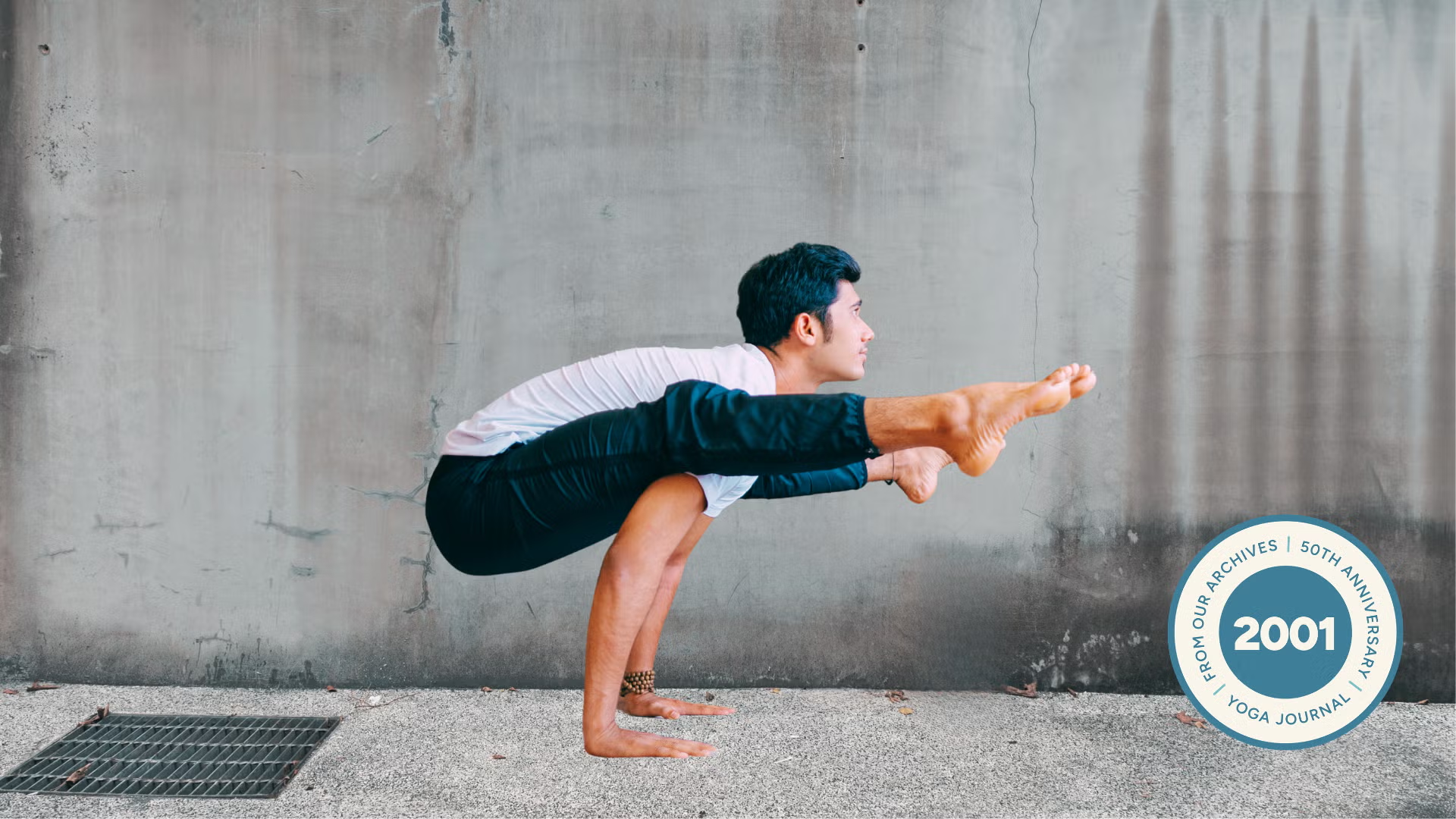
One such asana, or pose, is Tittibhasana (Firefly Pose). It is a challenging posture that, when expressed fully, requires tremendous flexibility, strength, and concentration. It’s also visually stunning.
At first glance, this asana may appear daunting or even impossible. However, as with other arm-balancing poses, you can make progress toward Tittibhasana by practicing less challenging asanas that include similar actions and movements. After all, our bodies really only engage in a few kinds of basic movements. We can bend forward or backward, left or right, or we can rotate around our core.
As your yoga practice deepens, more difficult poses require you to express these basic movements in combination. Still, if you analyze even the most complex poses, you can always find the same familiar movements. Knowing this may not make difficult asanas easier, but it can demystify them and help you realize that a regular practice will lay the foundation of endurance, increased range of motion, and concentration that leads to greater expertise (and, perhaps, arm balances).
How to Prep for Firefly Pose
There are a number of poses that can pave the way for Tittibhasana. One staple is Adho Mukha Svanasana (Downward-Facing Dog), which develops the upper body and arm strength that you need for arm balances. But strength isn’t the only challenge in Tittibhasana. Poor flexibility in the hips and spine can present an even greater hurdle. Let’s look at several poses that can help you work on these obstinate areas.
1. Child’s Pose
When we first learn forward bends, we often tend to incorrectly bend from the waist rather than correctly rotating the pelvis forward. Since continuing to bend that way will eventually weaken the lower back, teachers quite properly try to prevent damage by encouraging students to elongate the lumbar spine. Unfortunately, novices too often overtighten the muscles along the spine as they attempt to extend it. This action is an overcorrection that can result in the lower spine becoming habitually rigid and can also cause lower back strain in many asanas.
A more appropriate action is to engage your lower back muscles just enough to create a gentle toning that allows the spine space to safely adapt, whether lengthening, arching, twisting or, in the case of arm balances, rounding. A very simple yet potent asana to create more flexibility and awareness in rounding your spine is a variation of Balasana (Child’s Pose) in which the forehead is brought to the knees.
Begin by sitting on your heels and bending forward to rest your forehead on the floor, keeping your arms at your sides. In this forward bend, your breathing will slow down; the exhalation will naturally extend as your back muscles gently lengthen and widen. As your body settles into the pose, notice the rhythm of your breath in your back body and the sensation of movement your breath creates.
Let the breath’s massage undo tension in the back muscles and help the spine lengthen toward the tailbone. This release is a powerful demonstration that movement can be generated as much by letting go as by effort. As your back relaxes, rest your abdomen on your thighs and let the femur bones sink toward the heels. This last movement anchors your weight at the base of the spine, counteracting the tendency to be top-heavy and focus awareness only in your head and thus cut off from your belly: The belly must be alive and aware if you are to do arm balances well.
Still in Balasana, without lifting your chest off your legs, place your hands behind your head and pull your forehead as close to your knees as possible, deeply rounding the back. Many students tend to bend their backs by rounding strongly in the upper spine while remaining stiff and dull in the lumbar region. If you keep your chest on your knees, you really have no alternative but to engage your lower back muscles.
Certainly you shouldn’t force this roundong, but you should expect to feel a sensation of resistance in the muscles running along your spine and perhaps also in those running across your mid back. Once again, use the rhythm of your breath to help undo muscle tension throughout the back body.
Also, consciously lengthen your whole spine. I like an image that yoga teacher Victor Van Kooten uses to evoke this action. Imagine that each vertebra from the skull to the tail is a sneaker, and let them walk, heel to toes, down your back. I think this image works well because it encourages a subtle awareness of each vertebra’s independent movement.
2. Wide-Angled Seated Forward Bend
Extend your legs straight ahead of you and spread them wide apart in Upavistha Konasana (Wide-Angled Seated Forward Bend). Place your hands on the floor behind you for support as you position your pelvis at a right angle to the floor. If you have trouble achieving this, a folded blanket under your buttocks may help prevent your pelvis from slumping back.
Remain aware of your breathing rhythm, using each exhalation to help root your thigh bones to the floor. Soften your upper thighs, allowing them to move toward the hip joint, seating the femur head and freeing your hamstrings. Your weight should be centered on a line that runs down the backs of the thighs, the calves, and the heels.
Elongate your legs and keep your feet active by extending the ball joints of your toes forward. Once you can sit upright comfortably, move your hands to the floor in front of you. Exhale to tilt your pelvis forward, keeping your front body and your neck long and your chest broad. At the same time, continue to root the thigh bones.
This subtle action generates heat in the abdomen, a prelude to the intense abdominal action that helps you lift your pelvis off the floor in Tittibhasana. To explore this action more closely, as you sit in Upavistha Konasana, move your pubic bone down, away from your navel and back toward the tailbone, with each exhalation. At the same time, drop your tailbone to meet the pubis. These actions, when done correctly, will generate a distinct firming in your lower abdomen, but achieving the proper balance between them is a sophisticated gesture that can take time and patience to learn.
Yogis with tighter bodies will find the pubic bone movement difficult, while those with looser bodies may struggle with keeping the tailbone heavy. But learning to balance these actions is worth your attention and effort; it will result in valuable internal support for your pelvis and spine.
When you have deepened your forward bend to your maximum, reach out and hold the outer edges of your feet (Figure I). Now that your hands aren’t on the floor, you really need the abdominal support we’ve been focusing on. Breathing with sufficient intensity will help you marry the pubis and tailbone. Use the inner rhythm of your breath, especially the exhalation, to support this balanced action; feel your pelvis become light while your thighs remain rooted to the earth.
Upavistha Konasana generates heat in the belly; you can amplify this energy by tilting your pelvis forward until you encounter resistance in your inner thighs and then shifting the heat of that resistance from the legs into your belly by intensifying the actions of your pubis and tailbone. You might almost feel as though your pelvis could take flight. You will not be able to sustain such intense action in these small muscles for long, so play with it briefly and then ease off to a level of effort that will allow you to stay in Upavistha Konasana for a longer time.
3. Leg Over Shoulder
Another excellent stretch that can prepare your hips and lower back for Tittibhasana is a pose I call “Leg Over Shoulder.” Incidentally, it is also a good overture to forward bends, so you may choose to practice this exercise before doing Upavistha Konasana. Try it both ways to see which you prefer.
Begin by sitting with your legs extended straight out in front of you in Dandasana. Raise your right leg, bend your knee, and hold your right foot with your left hand. Then reach your right arm inside the leg to hold your calf. Breathe in as you lean back slightly and exhale as you push your right leg back, placing it over your upper arm as close to the shoulder as possible.
Continue to hold your foot with your left hand as you put your right hand on the floor. Feel how the position of your leg on the arm requires your back to round. Take a few moments to focus on your back. Keeping your chest broad, consciously release the tight parts of your spine, just as you did in Child’s Pose.
Next, push your right arm against the leg as the knee hugs the back of your shoulder; feel how this action creates movement in your hip joint. The head of your femur will shift toward the outer hip, and you may feel an internal rotation of the bone inside the joint. Generate a pumping rhythm by rotating your leg and pressing the knee into the shoulder as you exhale and then decreasing your effort slightly as you inhale. If you continue this conscientious coordination of breath and movement, you may feel your breath as a wave-like pulse that helps you gradually deepen your pose without straining or losing your deep internal focus.
Maintaining the alignment of your right leg, exhale and place your left hand on the floor and begin slowly extending your right leg (Figure 2). Do not be surprised if your leg won’t straighten much at all, much less completely. Still, if you exhale and lengthen your leg consciously, assimilating rather than forcing the stretch, you may be able to progress significantly over the course of several minutes. Continue to rotate your femur, squeezing your knee in toward the back of your shoulder so your leg doesn’t slide down the arm. Maintaining that action is more important than straightening your leg, since it both helps engage the ligamental girdle that supports and protects the lumbar spine and generates heat in your belly.
Straightening your leg in this pose is a prelude to straightening your leg in Tittibhasana. You must be able to balance the effort of maintaining support in your abdomen (by merging your pubis and tailbone) with the surrender of softening the hip (so the leg can rotate in the hip joint and elongate). Hold the leg extended for several breaths; then come out of the pose and repeat it on the other side.
Find the Shape of Firefly Pose
Now that you have warmed up your hips and back, you are ready to try to perch yourself atop your arms. Like riding a bicycle, or any other activity that relies more on equilibrium than on technique, balancing on your arms requires you to be totally present in your body. Part of your learning process must be a willingness to risk the tumbles that are nearly inevitable when practicing this asana.
First, you must establish a foundation position for your arms. Begin by standing in Tadasana (Mountain Pose) with your feet a few inches wider than hip width. Lean forward, bend your knees, and reach your right arm inside your right leg. Hold your calf as you place your right shoulder (or upper arm, if that’s what you can manage) under the back of your knee. Continue to hold your right calf to maintain the position of your right arm as you repeat on your left side.
Once you lock both upper arms in place, squeeze your knees against your arms and your arms against your legs to hold the position. Place your hands, fingers facing forward, on the floor a few inches behind your heels, shoulder-width apart or slightly wider. Spread your fingers wide and vigorously press the balls of your fingers and your fingers themselves into the floor. As you practiced in Child’s Pose, maintain awareness in your lower back by focusing on your breath and using it to mindfully relax any areas that are tight.
A safety note is necessary here. In Tittibhasana, your palms must be fully on the floor. This position requires that your wrists bend at a fairly acute angle. If you’re currently suffering from carpal tunnel syndrome or other repetitive stress injury to the arms, I would strongly advise against going further. But if your problem is inflexibility in the wrists, forearms, and hands, lessen the angle by placing a folded blanket or a wedge under the heel of your palm until you can tolerate the full wrist action.
Lift Off!
There are several actions must take place simultaneously.
• Activate your arms and press your fingers into the floor; this action creates reliable support.
• Make a strong effort to keep your shoulders over your fingertips.
• Keep your chest broad.
• Generate support in the lower abdomen by drawing your pubis and tailbone together.
• Keep your shoulders from shifting back and your hips from dropping, otherwise you will fall.
• Press your knees into your shoulders so that your legs don’t slide down your arms.
But there are only two keys to successfully transferring your weight to your hands: Plan your move carefully and make it decisively. Focusing on all these actions, exhale strongly and shift your weight to your hands. Keep your toes on the floor and stare straight ahead (Figure 3). Congratulations! If you didn’t fall over, you have established a secure base and are now ready to lift the legs and balance completely on your arms.
Maintain a steady breathing rhythm, making sure your exhalation is as long as your inhalation. Continuing to look forward, squeeze your upper arms with your legs and strongly extend your hands into the floor.
On an exhalation, squeeze your knees toward each other as you lift your feet slightly off the ground, crossing one ankle over the other and pressing them together. With another strong exhalation, lift your feet and hips higher, keeping them as level with each other as possible (Figure 4).
This position is a variation of Dwi Hasta Bhujasana (Two-Handed Legs over Arms Pose). It can help you get the hang of balancing, since it is somewhat less difficult than Tittibhasana. The strong action of pressing your feet against each other engages the legs and lifts your hips.
Unfortunately, the crossed feet also make it possible to cheat by simply hanging the legs on the arms and letting the hips sag toward the ground. To do the pose properly and to use it to gain insight in Tittibhasana, you must pay attention to all the details we’ve already discussed. Take a couple of calm, strong breaths and firmly root your arms. Engage deep abdominal support by merging your pubis and tailbone. Squeeze your legs into your arms while internally rotating your upper thighs and softening in your hip joints. And keep your chest broad while softly rounding and widening your back.
Since Dwi Hasta Bhujasana requires such strong action, hold it only a few breaths before uncrossing your feet, planting them back on the floor, and standing up in Tadasana. Check in with your back.
Perhaps the easiest way to enter Tittibhasana is to return to Dwi Hasta Bhujasana and use that pose to generate concentration and support before uncrossing the feet and straightening the legs into Tittibhasana. But let’s try the slightly greater challenge of lifting directly into Tittibhasana.
Begin by again bending over and reaching your arms back between your legs to place your palms on the floor. Prepare for Tittibhasana as before, confidently transferring your weight from your feet to your hands. Since you know it is quite difficult to simultaneously lift your hips and maintain the flexibility to straighten your legs, pause to collect yourself and focus your attention on the actions you’ll need for the pose. As you exhale, draw your pubis and tailbone toward each other, generating support within your pelvis so your hips do not drop as you strongly press your knees into your arms and lift the feet off the floor. Keep your knees bent for a moment and again consider your next move. Tittibhasana is a true exercise in balancing between effort and surrender.
If you push too hard through the legs, you’ll lose the internal rotation that keeps them hugging your arms. But without a strong lift in the lower abdomen, you’ll plop down on your derriére.
Again, gather together all the elements you need for a skillful demonstration of the asana. Engage the pubis and tailbone, broaden your chest, and look forward. Then, exhaling powerfully, extend your arms fully and, without allowing any other action to deteriorate, straighten your legs by extending the hamstrings, the calves, and the balls of the feet (Figure 5).
When you engage all the necessary actions at once, you may find they merge into a single clear intention that’s sustained by the regular beat of your breath. You become a firefly with light aglow in your belly, expressing a universal human drive, played out from Icarus to the Wright Brothers to today’s astronauts—the urge to fly.
After your muscles have relaxed a bit, you can also do a counterpose such as Setu Bandha Sarvangasana (Bridge Pose) to firm and strengthen lumbar muscles that may have been weakened by overstretching.
