



Published May 3, 2026 05:34AM
Yoga Journal’s archives series is a curated collection of articles originally published in past issues beginning in 1975. This article about Bridge Pose first appeared in the September-October 1992 issue of Yoga Journal.
In previous asana columns, I have discussed the importance of balancing the outer body and the inner body in our yoga practice. I have suggested that we should not rely on the force and effort of the external or superficial muscles, but instead awaken the deeper or internal muscles through the quiet release of tension so that the pose seems to grow from within. This shift of focus from the outer body to the inner body requires a different mode of perception as well as a more receptive attitude toward practice. The muscular sensations that inform us about the external body often prove misleading when we try to assess the basic alignment and balance of a pose.
For example, if your pelvis is habitually rotated so that the muscles of your lower back have grown thicker on one side than the other, placing your pelvis in a more balanced position often feels unnatural. Your muscles begin to work in unfamiliar ways, giving you signals that are difficult to decipher. You feel kinesthetically disoriented. The muscular sensations of the outer body may help you to distinguish between a pleasurable stretch and a potentially harmful strain, but they do not give you the kind of information you need to correct structural imbalances.
Muscular sensations can deceive or distract us in other ways. For instance, if I experience pain in a pose, my awareness is automatically drawn to the area of discomfort, which becomes my focal point.
But the location of the sensation doesn’t necessarily tell me the location of the problem. A pain in my inner knee might be due to tightness in my hip or a misplacement of my foot. When I allow my consciousness to be engrossed by muscular sensation, I tend to ignore the part of the body that needs adjustment.
We must move to a deeper level of perception where the gross sensations of the outer body will not distort our judgment. This deeper level of perception is informed by sensory receptors located in the joints and by the vestibular apparatus of the inner ear. The sensory receptors around the hip and shoulder joints are especially important in yoga, for they monitor the movement of the joints and tell us where we are in space. By listening to the body at this subtle level—that is, by attuning ourselves to the spaces in the body (the joints and cavities, the spaces between the bones)—we begin to perceive ourselves not as a patchwork of random muscle stretches and contractions but as a physical entity in the process of integration. Like a CAT scan or ultrasound, the sensory receptors of the joints help us to build a three-dimensional picture that brings depth and wholeness to our being.
Tuning Into Subtle Physical Sensations
When practicing the asanas, let your awareness penetrate deeply into the spaces of the joints. In each pose, observe which part of the joint tends to open and which part tends to close. Use your awareness to create maximum space in the joints. For example, in Adho Mukha Svanasana (Downward-Facing Dog Pose), notice how the front of the ankle joint closes, while the back opens readily. If you push your shinbones down into the ankle joints to bring your heels onto the floor, the front ankle will jam even more and the tendons at the back of the ankle will thicken and protrude. Instead, lift your shinbones away from the front of the ankle joint and broaden your heels. This adjustment will increase the flexibility of your ankles and allow you to lift your arches.
Likewise, the front of the shoulder joints open easily in Adho Mukha Svanasana because your arms are overhead, but the back of the shoulder joints are compressed. When you allow the back of the shoulder joints to close, your rib cage drops toward the floor, and the weight of your body falls heavily onto your shoulders. When you create space at the back of the shoulder joints, your rib cage lifts up away from your arms, your spinal column lengthens, and your pelvis and legs receive the weight of the body.
In Uttanasana (Standing Forward Bend), notice how the stretch of the hamstrings draws your attention toward the back of the thighs. In a forward bend, the back of the hip joint opens naturally, while the front of the hip joint closes. If you maintain a sense of space at the front of the hip joint when coming into Uttanasana, you will feel how the pelvis lifts over the thighbones to deepen your forward bend. Conversely, when you practice backbends such as Setu Bandhasana (Bridge Pose), the sensation of stretching comes at the front of the thighs and the groin area. In backbends, the front of the hip joint opens naturally, and the back of the hip joint is where you need to create space.
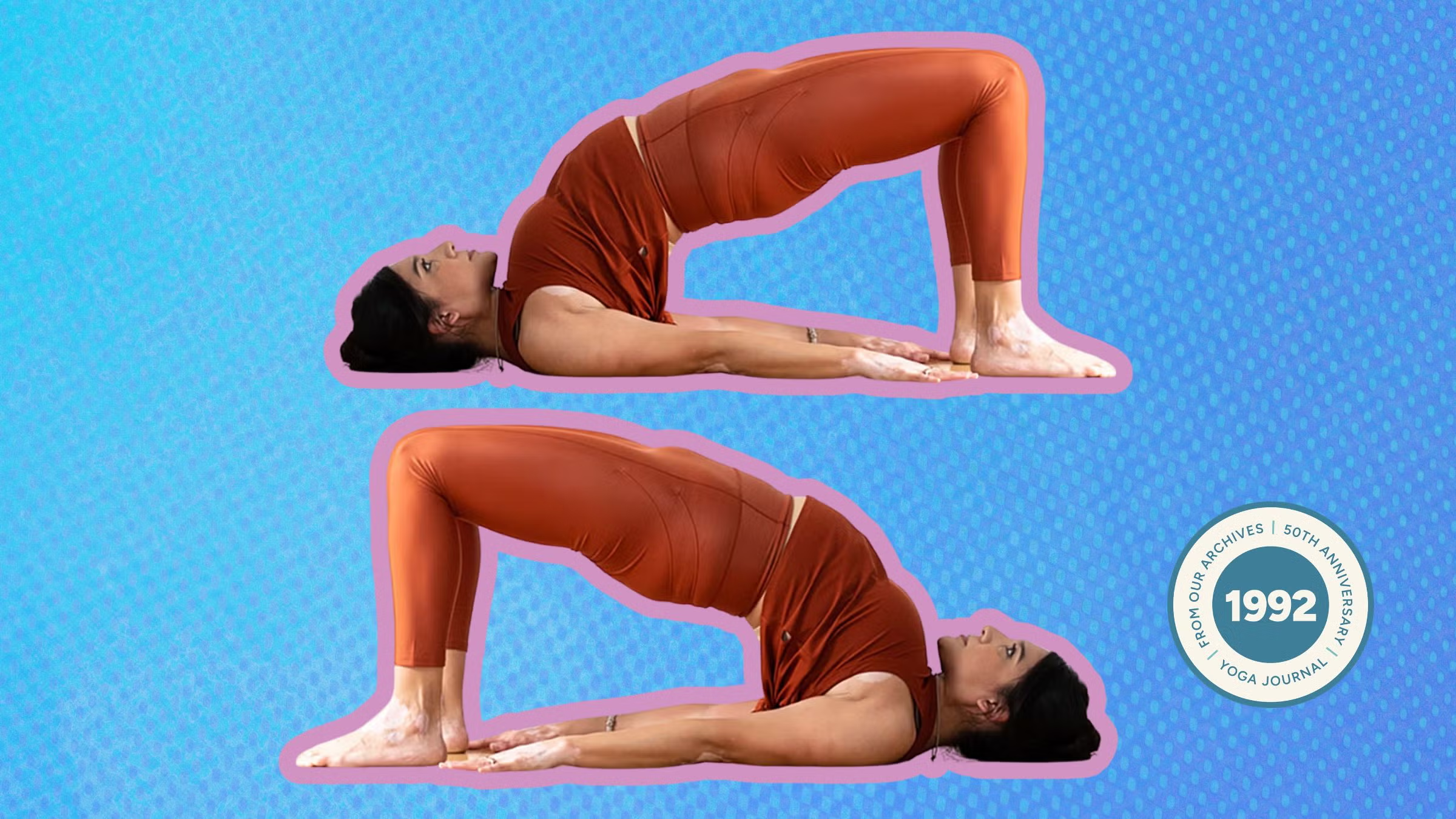
In Setu Bandhasana, the feet and the shoulders form a base for the pose, while the rest of the body arches like a bridge.
(Photo: Yoga Journal 1992)
How to Practice Supported Bridge Pose
As you practice the following variations of Setu Bandhasana, remember these two essential characteristics of a bridge: foundation and lift. Let the strength of the outer body provide the foundation, and let your awareness of the inner body enhance the lift.
The first variation of Setu Bandhasana is especially helpful for beginners and is an excellent preparation for Sarvangasana (Shoulderstand). First lie on your back with your legs extended and your shoulders at the edge of a neatly folded blanket. Bend your knees and place your feet firmly on the floor about six inches from your sitting bones and hip-width apart. Place a strap around your ankles and hold the strap with your hands a few inches away from the ankles (Figure 1).
(If you attempt to hold your ankles with your hands, your knees will move forward of your feet, which puts considerable stress on the knee joints. Using a strap ensures that the knees will stay directly over the heels with the shinbones vertical. If you feel any strain in the knees when practicing this variation of Setu Bandhasana, walk your feet two or three inches farther away from your shoulders. This adjustment should relieve the discomfort.)
Now relax your jaw and take a deep, soft inhalation. With the exhalation, press your upper arms into the floor and lift your pelvis, lengthening your thigh-bones out toward your knees. Keep the outer arches of your feet lifted and press your inner thighs down toward the floor, so your thighs stay parallel to each other and your knees don’t splay out to the side. Your buttocks should be firm but not clenched.
To come higher on your shoulders, lengthen your upper arms toward your elbows and press your shouldercaps, the top part of the outer shoulder, into the blanket. Think of lifting your shoulder blades away from the back of the shoulder joints to open your chest. Lengthen the front of your cervical spine so the base of your skull moves away from the shoulders, freeing the neck. Maintain this position for another half minute, then release your knees forward and bring your pelvis back down to the floor.
If you were unable to lift your pelvis to the level of the knees in this variation, try placing your feet on an elevated surface. Depending on how much additional height you need, you can place your feet on blocks, on a bench, on a low platform, or even on the seat of a chair. Place your props on a nonskid surface or against a wall for support. If using a chair, grasp the front legs of the chair instead of holding a strap around the ankles. By placing your feet on a raised surface, you will be able to lift the pelvis more easily and will come higher onto your shoulders.
For the next variation of Setu Bandhasana, you will need a block to support your sacrum and a wall to support your feet. First lie on your back perpendicular to the wall, with your shoulders at the edge of a folded blanket, your knees bent, and your feet flat on the floor close to your sitting bones. Your feet should be about 12 to 15 inches from the wall.
With a deep exhalation, lift your pelvis and roll your shoulders under. Then turn the block on end and place it under your sacrum so the tailbone sinks down over the far edge of the block. (The end of the block can be placed either lengthwise or crosswise under your sacrum, whichever feels more comfortable. Beginning students or those with a history of back problems can either set the block on its side or substitute a firmly rolled blanket so the pelvis is not lifted as high.)
When the block is in position, extend your legs and place your feet 10 or 12 inches up the wall, so your legs are parallel to the floor. Broaden the soles of your feet against the wall and lift your outer arches as you continue to extend the legs.
Check that your hips are level by pressing your fingertips onto your front hipbones.
If one hipbone is lower than the other, your pelvis is slightly torqued. From the top of the front hipbones, lengthen down through your inner legs to bring your pelvis back into balance. Then firm the core of your buttocks and stretch down through the back of your thighs.
Hold this position for another minute and then, if you feel comfortable, bring your feet down to the base of the wall.
With your heels on the floor, press the balls of your feet into the wall (Figure 2). As you continue to extend your legs, let the back of your hip joints open, so your thighbones descend. Feel how the work of the legs allows the chest to open and stretches the groin area. Remain in this position for two or three minutes, then bend your knees and bring your feet back to the floor. Remove the block and lower your pelvis. Extend your legs up onto the wall and dig your heels into the wall so your lower back presses into the floor, relieving any discomfort. Hold this position for several breaths before releasing.
The following variation of Setu Bandhasana, with the legs and pelvis supported by a bench and the head and shoulders resting lightly on the floor, is one of the most important of all restorative and therapeutic poses. The gentle opening of the rib cage enhances the circulation of the upper body and allows the lungs to breathe more freely. At the same time, there is a deep passive stretch of the groins and the lower abdomen, which tones the intestines and the organs of elimination. Thus both vital centers—the heart and the lower abdomen—receive nourishment.
Start by placing one end of a low bench (about 10 to 14 inches high) against a wall. (If you don’t have a bench, you can use bolsters, a low coffee table, or stacked blankets.) Place a folded blanket on the floor against the other end of the bench to support your shoulders, with the folded edge away from the bench. You may also want to put a yoga mat under the blanket to prevent it from slipping. I find that this position is more restful if I have a support under the rib cage as well as under the pelvis and legs.
Using one or two blankets, depending on their thickness, make a firm roll about 10 inches in diameter and place it against the end of the bench (Figure 3). Now sit on the bench with your legs extended and your feet toward the wall.
Tie a belt or strap around your thighs a few inches above the knees to prevent your legs and feet from falling out to the side. Tie the strap snugly rather than tightly so that you are still able to activate the muscles in your legs. To lower your torso, lean back and place your hands on the floor directly under your shoulders.
Then come down onto your elbows and, finally, release your shoulders onto the floor by sliding your elbows away. The top of your pelvis should now be resting at the edge of the bench, and your shoulders should be resting at the edge of the folded blanket. Make sure the blanket roll fits the curve of your back comfortably and is neither too low nor too high. Let your arms release our to the side with the elbows bent. You can remain in this position for five to 10 minutes with your eyes gently closed.
Supported Setu Bandha is an important pose to include in your practice, but it may take some time and experimentation to discover the best arrangement of props for your body. If you feel discomfort in your lower back when practicing Setu Bandhasana on a bench, try the following adjustments:
- Place an extra lift under your feet, such as a block or a rolled blanket, to raise the level of your legs a few inches and thus reduce the arch in your lower back. In most cases, this additional support relieves the discomfort.
- Put a blanket over the edge of the bench to provide a more cushioned support for your lower back.
- Check with your fingertips that your pelvis is level. If your pelvis is tilted to one side, you may be stressing your lower back.
- Place one or two sandbags (totaling 10 to 20 pounds) across your upper thighs. The weight of the sandbags brings the heads of the thighbones deeper into the hip joints. When the hip joints are freed in this way, stress on the sacroiliac joints is also reduced.
- Shorter and stiffer people can try a higher lift under the shoulders. Those with a long torso can try a higher lift under the pelvis so the spine has more room to lengthen.
When you want to come out of the pose, bend your knees into the chest and undo the strap. Then place the soles of your feet on the bench and slide your pelvis off. Remove the blanket roll from the end of the bench so you can rest your pelvis on the floor as close to the bench as possible. Let your knees drop out to the side and bring the soles of your feet together as in Baddha Konasana (Bound Angle Pose). You can hold the strap around the feet to keep them in place. I like to stay in this position for two or three minutes after practicing supported Setu Bandhasana because it relieves any discomfort in the lower back. When you feel the hip joints release and relax, use your hands to bring your knees together and turn onto your side to come up.
When you have mastered the preceding variations of Setu Bandhasana, you are ready to practice the final version of the pose. First lie on your back on a nonskid mat with your shoulders at the edge of a folded blanket. Bend your knees and place the soles of your feet on the floor a few inches from your sitting bones. Extend your arms toward your feet with your palms spread on the floor.
Take a deep inhalation and, with the exhalation, lift your pelvis as you press your upper arms firmly into the blanket.
Interlock your fingers behind your back and lengthen your arms toward your feet as you roll your shoulders under. Now come up onto your toes and lift your pelvis. Bring your hands onto your lower back with your thumbs pressing the sacroiliac joints and your fingers supporting the outer hips. Draw your elbows in (so your upper arms are parallel) and lift the weight of the pelvis off your hands. Keep your pelvis lifted as you bring your heels back down to the floor.
When you are able to keep the weight of the pelvis from sinking onto your hands, you are ready to move to the next stage. Once again come onto your toes and lift your pelvis higher. Bring your hands onto your rib cage with your palms flat and your fingers pointing toward the waist as in Sarvangasana (Shoulderstand).
Bring your heels down to the floor, but keep your pelvis lifted so the weight of your upper body does not collapse. When you feel compression in the wrist joints, you know the legs and the buttocks are not providing enough of a lift. Continue to practice this stage of the pose until you feel that the rib cage remains light in your hands and there is space in the wrist joints.
To extend your legs, first shift your weight onto the left foot. Bend your right knee into the chest, then extend your right leg toward the ceiling. Keep your pelvis lifted as you extend your right leg in a wide arc and place the right foot on the floor. Then bend your left knee into the chest, straighten the leg, and reach the left leg out with a broad circular motion to bring the left foot to the floor.
Keep the core of the buttocks firm and the pelvis lifted so that your chest opens away from your hands. Lengthen your upper arms toward the elbows to release your neck and the base of your skull away from your shoulders. Keep your legs active and your upper body receptive. When you lose the feeling of lift and the weight descends onto your wrist joints, walk your feet back, remove your hands from the rib cage, and release the pelvis back to the floor.
When we bring our awareness to the inner body, creating space in the joints, the gross sensations of the outer body still remain, but we interpret them from a different perspective. We are no longer distracted or overwhelmed by feelings of pleasure and pain, but are guided by an intelligence that seeks balance and harmony. In the yogic tradition, this shift in level of perception is known as pratyahara, withdrawal from the senses, and is the fifth of the eight stages of yoga. For me, pratyahara signifies not a closing down of our awareness of the outer world, but a commitment to the infinite potential of the life within us.
