



Published May 15, 2026 08:35AM
Yoga Journal’s archives series is a curated collection of articles originally published in past issues beginning in 1975. This article about Reverse Plank (Purvottanasana) as well as some essential principles of yoga first appeared in the July-August 1995 issue of Yoga Journal.
The Sanskrit word sutra means “thread.” To the yogis, a sutra is an aphorism—a concise statement or rule—and any instructional manual consisting of such aphorisms woven together like threads. Patanjali’s Yoga Sutras is one such manual. Compiled sometime in the third century C.E., this fundamental treatise of classical yoga comprises 195 aphorisms, of which only three—with a grand total of 10 words—are dedicated to the art of asana or posture.
Patanjali’s intent, of course, wasn’t to describe asana practice in detail. Rather, he gives us a kind of conspectus of the ideal asana, a standard by which we can judge whatever posture we’re performing.
Remember that, to Patanjali, asana practice is a preparation for intensive breathing and meditation exercises, which demand that the yogi sit for hours on end without fidgeting or slumping. In fact, the word asana literally translates as “seat.” So Patanjali’s main criterion for an asana is that it be “steady and comfortable.” This induces, in his words, a “relaxation of tension” and the experience of the finite body as coinciding with ananta, the “endless” or “infinite.” The body is perhaps the most basic tool of liberation. “Liberation,” proclaims the ancient text Sarva Darshana Samagraha, “results from knowledge, knowledge from study, and study is only possible in a healthy body.”
In this context, the aim of asana practice is to transcend what Mircea Eliade describes as the “modalities of human existence,” which sweep us along on the “rushing stream of states of consciousness,” and so contribute to the never-ending painfulness of embodied existence. Patanjali calls these modalities—like joy and sorrow, pain and pleasure—the dvandvas, the “pairs of opposites.”
But not all yogis agree that in life, as Patanjali maintains, sarvam dukham, or “all is suffering.” Others affirm that life is an outpouring of divine bliss, the spontaneous self-expression and self-amusement of the Absolute. These pairs—light and dark, expansion and contraction, revelation and concealment, unity and diversity—are not dualities in conflict with each other and with the soul, but the “dancing partners” of its creative tension.
Through asana, these yogis encourage us to join in the dance—and thus the world and its source. We arrive at the balance point not by separation or moving away, but by integration, by making whole. Then our practice encompasses and celebrates all of our experience, and yoga becomes a way of life, not a way out of life.
Is it possible to stand Patanjali on his head? To embrace, through our practice, the pairs of opposites and discover from this how to stretch ourselves to the fullest, not only in asana, but in our daily lives as well?
Understand Your Body, According to Yoga
There are, in fact, two traditional pairs that are easily accessible to anyone with a body. One pair of opposites—right and left—symbolize the complementary faces of the Absolute. The dakshina side, which means both “right” and “south,” is the dynamic feminine power, Shakti; the uttara side, “left” and “north,” is Shakti’s spouse, Shiva, the quiescent witness of her cosmic play. The holy couple unite, in the marriage of yoga, in the middle of the body (or in the middle of any part of the body). B.K.S. Iyengar calls this middle the “median plane,” the plumb line for all measurement, the “God,” he says, of all extension, alignment, and poise.
Many beginning students intuitively recognize that the two sides of their body are somehow different people, frequently working at cross-purposes in an asana. They’ll sometimes jab an accusing finger at the left or right, faulting it as the “bad side,” when it refuses to cooperate with the “good side” in some desired movement.
The second pair of opposites is the back and front of the body. We know the front body intimately. But the back represents the forgotten or shadow side of our consciousness, literally “out of sight, out of mind.” Think for a moment. What does your back look like? How do you feel about the back of your body? How do you speak to your back, and how do you listen to its voice?
Appropriately, the yogis designate the back as pashima, which literally means both “being behind” and “west,” the direction of sunset. The front is the light side of consciousness, purva, meaning “being before” and “east,” the direction of sunrise. It is the visible body, the body we see every day in the mirror. The back is the tactile body, always hidden from view.
Most beginning students find it hard, if not impossible, to get in touch with their backs. In the West, with its emphasis on rationality, the eyes and brain—or at least what contemporary yogis label the “front brain,” probably akin to the neocortex—dominate our awareness. Our feelings typically get elbowed onto the back burner, neglected though nonetheless simmering away.
The first step in practicing asana is to investigate the existing pairs in our body—the “good” and the “bad,” the “light” and the “dark” sides of our selves-and accept and learn from who we currently are. We then can work to resolve any conflict, arrange a peace treaty between the sides, and embody the equanimity valued by all yogis. As Iyengar notes, “Yoga is working your body equally on both sides.”
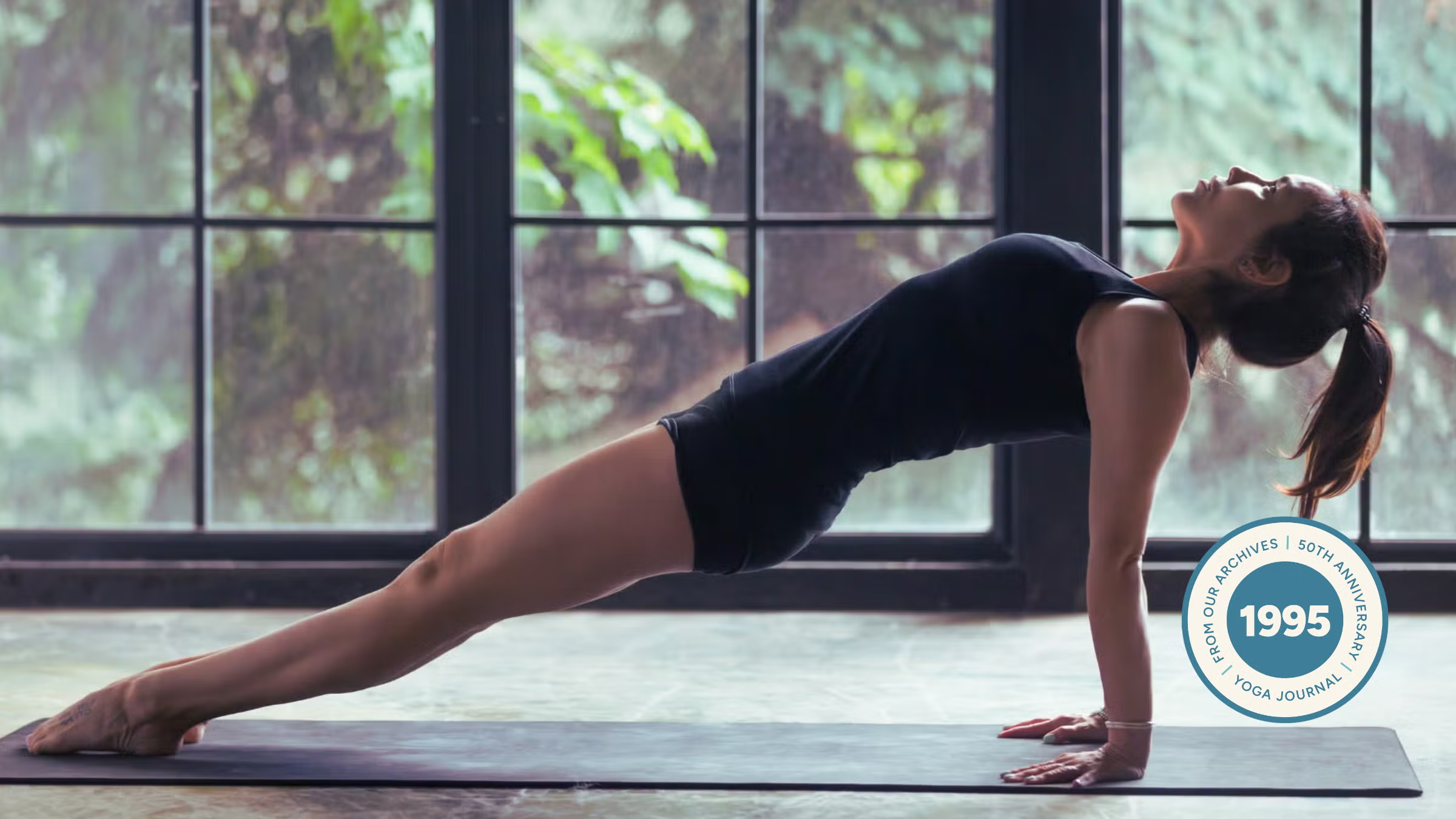
In this article we’ll look at a posture named Purvottanasana, which literally means the “intense extension of the east side,” but which is commonly known as Reversed Plank Pose. This posture can be used as a counterbalance to the deeper forward bends, several of which are named for the back or west side, pashcima. Like other symmetrical postures, in which the sides operate in parallel, Purvottanasana is a simple and direct test of our skill to engage and coordinate our body pairs.
How to Practice Reverse Plank (Purvottanasana)
Warm-Up
I always begin my asana practice lying on my back on the floor with my knees bent and my arms out to the sides. The contact with the floor helps me shift awareness to my back, my “dark side,” and bring it toward the light.
We’ll be working with the shoulder blades or scapulas, so pay special attention to the upper back, where these bones are located. What do they feel like to you? My right scapula, the “bad” one, always digs unpleasantly into the floor, while my “good” left scapula lies agreeably against the ribs.
I first try to imitate on the left what I’m feeling on the right, which gives me a clearer picture of where and how the right goes wrong. Then, as I slowly release the left, I gently coax the right to follow suit. As Iyengar says, “When one side of the body is doing better than the other, the other has to become the guru of the first.”
Imagine that the floor is pushing up against the scapulas and, at the same time, push lightly with your heels against the floor so the scapulas scrub toward your waist. Soften the kidneys and lungs and let the scapulas penetrate deeply into the organs as the chest opens toward the ceiling.
Reverse Plank Prep Pose 1
For the next exercises, you’ll need two props that no yoga home should be without: a metal folding chair and a yoga block (though you can substitute a stack of books or folded blankets for the block).
Brace the chair back against your yoga wall and have your block (or whatever prop you’re using) handy. Sit on the chair near the front edge of the seat, knees above ankles. Place your hands on the seat near the back edge, with the palms turned up and the thumbs pointing toward each other, and push the pinky sides of the hands against the inner chair frame. You should feel—and you want to promote—an inward rotation of the upper arms and a conscious spreading of the scapulas.
Incidentally, if the pressure of the backs of the hands on the chair seat hurts now, it will only get worse as you go along in this exercise. As Patanjali says, the “pains which are yet to come can be and are to be avoided,” so pad the seat with a sticky mat.
Exhale, lift your buttocks off the seat, and slowly squat down. Wait. Is there a stretch across the upper chest and front shoulders? If you can, reach your legs out and sit on the floor (Figure 1). If it seems like your arms are going to tear off, come up quickly, place the block on the floor just in front of the chair, and head down again. Try sitting on the block with legs extended: If the shoulder stretch is bearable, stay in that position; but if there’s still too much discomfort, adjust the lift under your buttocks until you can sit without undue strain.
Round the shoulders well forward and sink the chest, and continue to accentuate the inward rotation of the arms and the spreading of the upper back. Then exhale, sink the thighs heavily into the floor, and press the scapulas into the ribs. This action should initiate the lift of the chest. Be sure you don’t de-rotate the arms or squeeze the scapulas toward each other and the spine, closing the space in the upper back.
Stay for one to three minutes. Equalize the stretch across the upper chest, from the breastbone or sternum out along the collarbones, and the upper back, from the spine out along the scapulas. Then exhale, slowly lean forward, and slide your hands off the chair.
Reverse Plank Prep Pose 2
For the uninitiated, the next exercise may seem a little odd, but then if you’re worried about being odd, you probably shouldn’t be doing yoga. Skip this exercise if you have any serious back problems—just lie on a small blanket roll instead, knees bent.
Place your chair about a foot or two from the wall, and have your block within reach to one side. Sit backward in your chair—that’s right, slip your legs through the space between the chair seat and back, and wiggle in until your belly comes right against the chair back.
Grab onto the chair back and stick your heels—or as much of your heels as you can-where the wall meets the floor. Then with an exhalation, shove the wall away from you, straightening the legs as the chair slides backward (if you’re working on a carpeted floor, your chair may not slide easily away from the wall).
If you’re a bit shorter, or if you have some lower back aches, elevate your heels on a second block or the Yellow Pages.
As you did in the first exercise, press the scapulas into the ribs and open the chest. Exhale and, with the chest still bolstered by the scapulas, carefully lower yourself backward onto the chair seat. I like to get the lower tips of the scapulas against the front edge of the seat and the tailbone against the back edge, but this may not be possible for you. Make sure, though, that some part of your scapulas are pressing on the seat edge, and then use that contact to consolidate your awareness of these bones as they burrow deeper into the ribs.
Reach for your block and bring it under the back of your head. This prop is supposed to prevent neck strain: If your neck feels relaxed, then stay, but if it doesn’t, you’ll need additional height— try your favorite yoga book below the block. Now you’re in supported backbend (Figure 2). Keep the thighs firm and the heels pressing down. The belly should be as soft and billowy as possible, and don’t forget to breathe. You can continue to hold the chair back with your hands, or grip the back legs of the chair. Stay from one to five minutes.
Before you try to come up, bend the knees, put the feet on the floor, and take hold of the chair back again. Exhale and, hanging the head backward, drive the scapulas into the back as you pull with the arms, leading the movement with the sternum. Then open your legs and hang forward over the chair back for a minute or two before coming out of the chair.
Reverse Plank Prep Pose 3
Bring the chair a few inches away from the wall. Sit near the front edge of the seat, knees above heels, and grip the back corners of the seat—or the sides near the back—with your hands. As you did earlier, inwardly rotate the upper arms and spread the scapulas wide. You’re about to lift the buttocks off the chair. Make sure that you’re slightly pigeon-toed, that the knees are no wider than the hips, and that the inner thighs are very active to hold the knees in place.
Exhale and, keeping your knees bent, move the scapulas up and into the back, and curl the tailbone up and out to the backs of the knees. Imagine that you’re being boosted from behind, as if by a secret hand. As the back of the body rises, let the front of the body open to accept the movement.
Press the heels firmly into the floor. Look down the length of your torso and thighs. Does this indeed look like a sturdy plank or is there a sag? If your back isn’t fully participating or your front isn’t in a receptive mood, the shoulders and/or pelvis may be sinking, and you’ll then be doing what I call an anti-asana, known here as the warped variation of Reversed Plank.
Soften and widen the top buttocks, but squeeze the lower buttocks over the sit bones and the hamstrings at the backs of the thighs. Rest the head on the wall.
This is stage one. Stay for one to two minutes, breathing easily. If this was a relatively happy time in your life, then go on to stage two: Come up again with the sensation of being lifted, extend one leg at a time, pinning the mounds of the big toes and inner heels against the floor. Now the plank should slope evenly, like a ramp, from the feet to the head (Figure 3). Stay one to two minutes.
Finally, before moving into stage three—if you decide to accept the mission—spread your palms flat on the chair seat with your fingers pointing toward the front edge. This hand position will ready you for the final posture: Be sure, when you’re in the posture this time, that you’re pressing resolutely through the mounds of the index fingers and thumbs and the inner wrists. If you’re tight in the front armpits and biceps, the scapulas will be especially challenged to secure the proper lift of the sternum. Hold this last stage 30 seconds to one minute.
Reverse Plank
If you’re just starting to practice this posture, or if you have any problems with your neck, you should have a chair behind you, with one or two folded blankets on the seat, to cradle your head.
Also, once in the posture, you can push your heels against a wall, or prop the balls of the feet on a folded sticky mat, to reinforce the action of the legs.
Traditionally, Purvottanasana is launched from Staff Posture (Dandasana). Sit on the floor with legs straight and torso vertical. Lean back and bring the palms to the floor somewhat behind you. If you had difficulty with stage three of the previous exercise, start by turning the fingers away from the feet and rotating the arms outward. Otherwise, point the fingers toward the feet and rotate the arms inward.
Bend the knees slightly, exhale, and lift the buttocks off the floor, straightening the knees as you do (Figure 4). It’s possible, by the way, to keep the knees bent at right angles here—particularly if you’re struggling with the chest and armpits—and perform a kind of Reversed Table. Whatever you do, remember that this lift is effected from the back body, and that the front body is draped over the back’s supportive frame.
As the scapulas lift, move the sternum parallel to the ceiling in Purvottanasana. If there’s someone around who understands your strange obsession with yoga, have him or her straddle your legs and hoist you, first from the scapulas and then from the back of the pelvis. Stay from 30 seconds to one minute, exhale, and release.
Each asana is a small step in the cosmic dance of Shakti and Shiva, a gesture of celestial grace and significance. By embracing the pairs of opposites in the body and mind, the yogi realizes, in the words of Sri Aurobindo, the “soul of good in all things that have the contrary appearance; that soul is delivered in them and out of them, the perversions of the imperfect or contrary forms fall away or are transformed into their higher divine truth.”
