



Published April 29, 2026 01:04PM
Yoga Journal’s archives series is a curated collection of articles originally published in past issues beginning in 1975. This article about Extended Side-Angle Pose (Utthita Parsvakonasana) first appeared in the March-April 1992 issue of Yoga Journal.
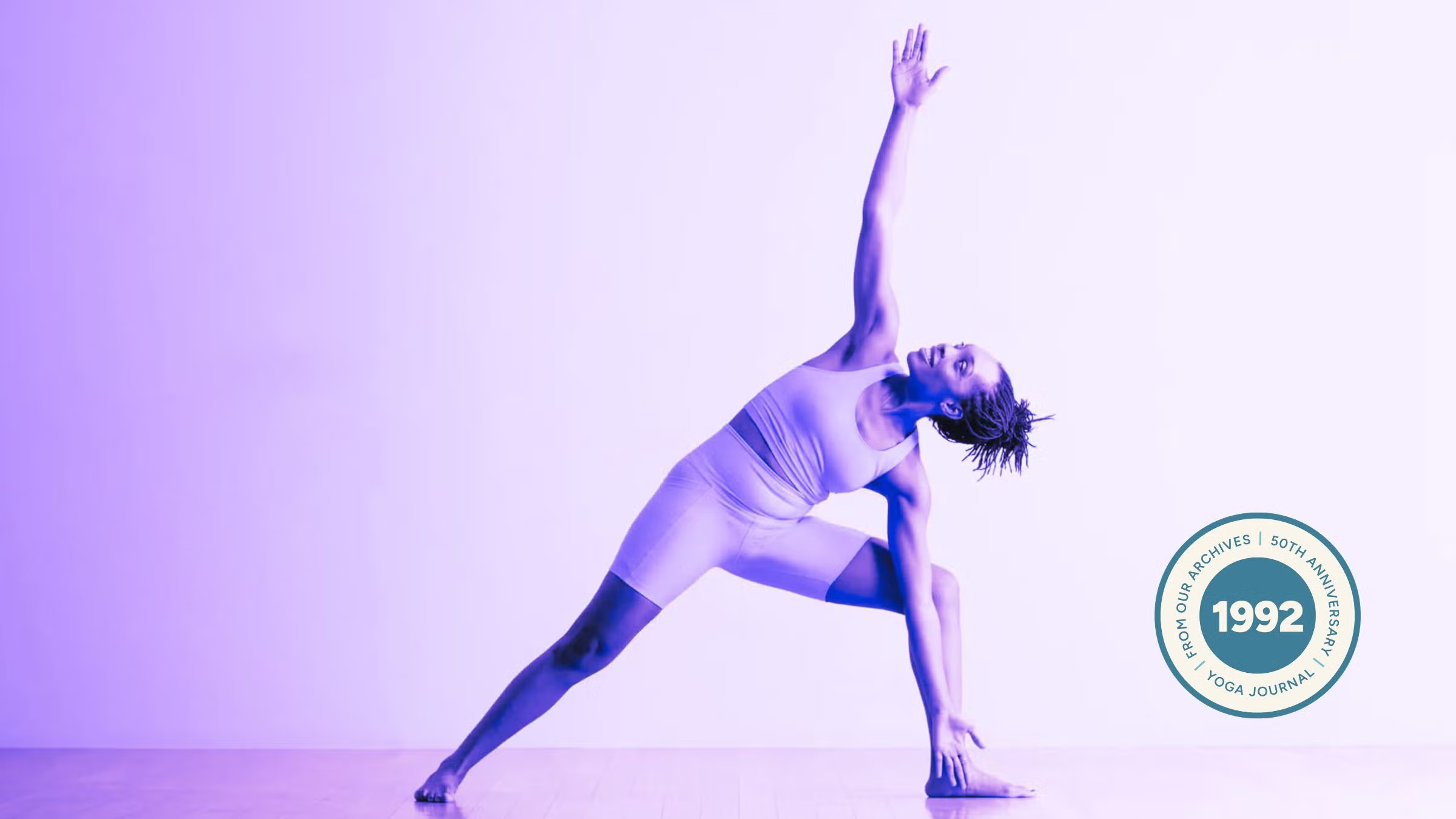
In Extended Side-Angle Pose (Utthita Parsvakonasana), we begin by establishing the basic structure or scaffolding of the pose. The front foot is placed in line with the arch of the back foot so the whole pose can be contained within one plane, like a two-dimensional figure in Euclidian geometry. A sense of direction and vitality comes from the long diagonal line that stretches from the outer heel of the extended leg, through the upper side of the torso, all the way to the fingertips of the extended arm. The bent knee forms a right angle, with the front thigh parallel to the floor and the shin vertical, giving stability to the front leg. This basic alignment provides the outer framework from which we begin to explore the inner workings of the pose.
Extended-Side Angle Variations
A variation of Extended Side-Angle Pose, using a chair placed against a wall for support, is especially helpful for beginning students. This variation develops the strength of the straight leg and allows for a greater stretch of the inner thighs. First stand in Mountain Pose (Tadasana) about three feet from the chair, with your right side toward the chair. Turn your left heel out about 30 degrees and bring your right foot onto the seat of the chair with the right toes turned out 90 degrees. When your right leg is fully extended, your left foot should be directly under the left hip-socket.
Place your hands on your hips and relax your shoulders. With an inhalation, lengthen down through the inner left leg and lift the spine. Keeping the left leg strong, with an exhalation bend the right knee until it is directly over the heel.
With the next inhalation, raise your arms to shoulder level and lengthen out from the shoulder blades to the fingertips. On the exhalation, lift the pelvis over the right thigh as you lengthen the right side of the rib cage along the top of the thigh. Make sure that the right knee stays directly over the heel. Let your right arm come in front of the right leg to hold the knee in place and bring your left hand onto the left side of your waist.
(Photo: Yoga Journal, 1992)
Press your right elbow against your inner right leg and lift your torso away from the right arm, so your rib cage faces directly forward. Roll your left shoulder back and extend your left arm overhead with the palm of the hand facing down (Figure 1). Hold this position for several breaths, lengthening the inner thighs away from each other and lifting the spine. Then, with an inhalation, draw yourself up by lengthening the left arm back in a wide circle. Bring your right foot back to the floor and stand for a moment in Mountain Pose. Then turn your left side to the chair and repeat the pose to the other side.
Finding Alignment in Side-Angle Pose
Proper alignment creates stability and strength, balances the work of the muscles, and protects the joints and the spine from injury. Yet if we think of alignment only in terms of the outward shape of a pose, we are in danger of using the effort and tension of our external muscles to hold ourselves rigidly in place, rather than allowing the pose to grow naturally from within.
At a deeper level, alignment involves integration, bringing one part of the body into an appropriate relationship with another. The subtle energy of the body is allowed to flow freely between them, leading to a sense of wholeness and connectedness. In the standing poses, our goal is to transmit the energy and strength of the legs through the pelvis to help support and lengthen the spine. For this to happen effectively, the pelvis must be in a neutral position relative to the legs.
You can test this for yourself by standing in Mountain Pose with your feet a few inches apart and your hands on your hips. First tilt your pelvis forward, so the sitting bones lift up and back and move nearer to the surface of the skin. Feel how the lower back is overarched in this position and how the weight of the upper body falls on the lumbar spine.
Return to Mountain Pose and try the opposite movement. Squeeze the buttocks together and tuck the tailbone under, so the top of the pelvis tilts back and the lumbar curve flattens. Feel how the sitting bones are pushed forward and down and how the upper spine collapses because it has no support. In this position, it’s difficult to straighten the knees or lengthen the back of the legs.
Now try to find the middle way between these two extremes. Come into Mountain Pose once more and let the sitting bones point toward the heels. When the pelvis is in this position, the spinal column balances easily on the sacrum.
As you lengthen the legs down, draw the sitting bones up into the flesh of the buttocks, so a firmness comes to the base of the buttocks and the muscles at the top of the back thighs. Feel how the energy lifts through the center of the spinal column in response to the action of the legs. Now return to Extended Side-Angle and try to recreate in the extended leg the feeling you just had in Mountain Pose. The following variation of Extended Side-Angle is helpful for students who are unable to bring the front thigh parallel to the floor, because of either tightness in the hip joints or weakness in the legs.
Starting from Mountain Pose, spring your feet four and a half to five feet apart, or as far apart as feels comfortable and secure. Turn your left foot in 30 degrees and your right foot out 90 degrees. Place a wooden block by your outer right ankle (Figure 4). (Flexible students can place the block flat on the floor. Those who are stiffer can place the block on end. If a block is not available, use a thick book.)
On an inhalation, lift the spine and raise the arms to shoulder level. On an exhalation, bend the right knee so it comes directly over the heel. (If your knee goes beyond the right heel, you need a wider stance.) With another inhalation, lengthen the back leg and lift the spine. On an exhalation, extend the right side of your torso along the right thigh, and bring your right hand onto the block. Place your left hand on your outer left hip with the elbow bent.
Now check the position of your pelvis in relation to the extended leg. Bring the left sitting bone in line with the back of the left heel. As you lengthen the back of the left thigh, draw the left sitting bone up into the flesh of the buttocks, that is, toward the head. As the base of the left buttock becomes firm, feel how the pelvis lifts off the right thigh and the front rib cage turns toward the ceiling. Then roll the left shoulder back and extend your left arm overhead, with the palm of the hand facing down.
Maintain this position for several breaths. Press down on the inner left heel to draw the left sitting bone deeper into the body. Lengthen the inner left arm to create an unbroken stretch from the left heel to the left fingertips. Let the inner body follow the movement of the outer body, lengthening the spine in both directions and allowing the chest to open from within. The breath should remain soft. When you have reached a state of deep inner quiet, come up on an inhalation and repeat to the other side.
Discovering the Psoas
When the legs have been strengthened and the pelvis is properly aligned, you can begin to cultivate an awareness of the deeper muscles. Perhaps the most important is the psoas muscle, which lies deep in the abdomen. As shown in Figure 2, the psoas originates along the front of the lumbar spine and attaches to the sides of the lumbar vertebrae and the intervertebral discs (the pads of cartilage that separate the vertebrae). From the sides of the lumbar vertebrae, the psoas runs diagonally through the pelvic cavity, crosses over the crest of the pubic bone, and inserts on the head of the thighbone.
Because it connects the lumbar spine with the legs, the psoas helps to maintain stability while standing erect. Furthermore, the action of the psoas helps to lift the legs in walking. As Ida Rolf emphasizes: “The legs do not originate movement in the walk of a balanced body; the legs support and follow. Movement is initiated in the trunk and transmitted to the legs through the medium of the psoas.”
The psoas also affects the upper body through its relationship diaphragm. The psoas originates at the front of the lumbar spine in close proximity to the two flaps of the diaphragm called the crura, which attach like the guide-ropes of a parachute to the front of the lumbar spine. Any tension or dysfunction of the psoas is communicated through the diaphragm to the upper torso, creating tightness in the upper back and shoulders and affecting the breath. The psoas is thus at the center of an inner network of muscles that governs the entire body.
If you want to locate the psoas in your own body, try the following exercise. Lie down on your back with your knees bent and your feet on the floor close to your buttocks. Place your fingertips on your lower abdomen about two inches to either side of, and an inch or so below, the navel. Relax your lower abdomen and press deeply but gently with your fingers, as you slowly bring your knees toward your chest. The muscle that you feel contracting deep under your fingertips is the psoas. (Don’t be distracted by the contraction of the surface abdominal muscles.)
Some people find it easier to locate the psoas by testing the two sides separately, raising one leg at a time and checking with the fingers whether the right psoas feels tighter or looser, thicker or thinner, than the left psoas (Figure 3).
When we talk of the psoas in the singular, we tend to obscure the dual nature of this muscle. Actually, there are two psoas muscles—a right and a left, which generally work in an alternating or reciprocal way. In walking, for instance, when we bring the right leg forward, bending and lifting the knee, we first shift the weight to the left leg. At this point, the left psoas stabilizes the body, while the right psoas recedes toward the back wall of the pelvis to lift the right thighbone. Walking is thus an asymmetrical activity that is mirrored in such standing poses as Extended Side-Angle, where the back leg provides stability while the torso is brought closer to the front leg.
How to Practice Extended Side-Angle Pose
Let us practice Extended Side-Angle again, this time focusing on our physical center deep in the lower abdomen and initiating all movement from there. From Mountain Pose, spring your feet four and a half to five feet apart, turning your left foot in 30 degrees and your right foot out 90 degrees. Shift your weight onto the left side of the abdomen (as you would in walking), and lengthen from the left psoas down through the inner left leg as you bend the right knee to a right angle. (If you don’t feel the connection of the left psoas to the inner left leg, press your fingertips into the left side of your abdomen as you make this adjustment, as in the psoas location exercise above.)
On an inhalation, lift the spine out of the pelvis and release from the inner shoulder blades out toward the fingertips. On an exhalation, continue to lengthen the back leg from the left side of the abdomen and draw the right groin (the very top of the inner thigh at the hip crease) deep into the body as you lift the pelvis over the front thigh and lengthen the right side of the rib cage. (Softening the right groin and drawing it into the body should prevent the crunching sensation in the right groin area which many students complain of in this pose. When you make this adjustment, the flesh will feel as if it is moving away from the surface of the skin.) Place the fingertips of your right hand on the floor by the outer right ankle and bring your left hand to the outer left hip.
Now bring your awareness to the pelvic area. Let the head of the left thigh-bone lift away from the head of the right thighbone, so the inner groins soften and the base of the pubic bone becomes wide. As you release the tension in the hips and groins, the stretch of the extended leg out of the abdomen becomes easier and more sustained. Then lift the weight of the torso off the groins and release the right shoulder blade away from the spine, extending down through the inner right arm. Let the left shoulder blade release out toward the left elbow as you roll your left shoulder back and turn your head to face the ceiling. When you release the grip of the shoulder blades on the back rib cage, feel how the lower abdomen broadens and supports the lift of the front lumbar spine.
When your left shoulder comes behind your left ear, extend your left arm overhead with the palm facing down. Keep your diaphragm soft and wide, so your left arm can lift out of the base of the abdomen. Lengthen the front armpit area at the left side of the chest to release deep in the left shoulder joint; then lengthen your inner left arm so the muscle flattens against the bone.
As you release the tension of the outer muscles and create space in the joints, the impulse for change and renewal will arise from deep within the body. Watch for a slight involuntary movement starting deep in the hips or pelvis and extend it out through the spine and legs, so the outer body expresses the subtle movements and spontaneous realignments of the inner body. When this process feels complete, use the strength of the abdomen to lift out of the pose and repeat to the other side.
In our practice of hatha yoga, we maintain the outward form of a pose by giving expression to what lies within. Durkheim describes the subtle interplay between the inner and the outer body in this way: “The inner and the outer exist not against but for each other. The visible form seems neither forced nor slack, neither dissolving nor rigid but just what it is, maintaining itself yet constantly adapting—in short alive. From moment to moment, the inner life fulfills itself in a consistent outer form, and conversely this form renews itself constantly from within. At every moment the outer appearance is the expression of a renewal of life, reanimating the whole again and again.”
