


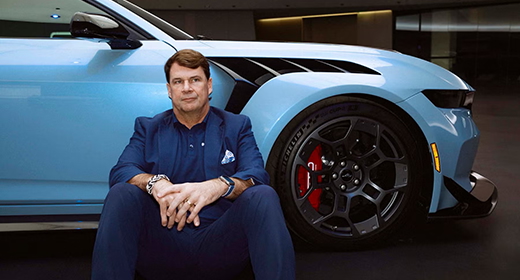
By Jamie Kitman: Five years into driving Ford, CEO Jim Farley talks to C/D about the tough road ahead of him and how he’s navigating competition from China.
From the March/April 2026 issue of Car and Driver.
Ford Motor Company CEO Jim Farley recently marked his fifth anniversary in the Blue Oval’s top job. Lately, he’s been criticized, as has the leadership at many legacy carmakers, for his company’s money-losing electrification drive, capped recently by the cancellation of the F-150 Lightning, the dissolution of two initiatives with Korean battery makers, and a $19.5 billion write-down related to business-plan changes. A new, more modern EV platform—representing a “Model T moment” for Ford, according to Farley—is set to debut as a mid-size pickup in 2027, built in a retooled Kentucky plant. While it points toward the next steps in Ford’s effort to catch up with the EV industry’s front-runners, which include many Chinese companies, questions remain. How did Ford get to this point? What needs to change? And, in an industry experiencing as much flux as it ever has, can Ford catch up? The 63-year-old executive sat down with Car and Driver contributing editor Jamie Kitman to discuss what’s gone wrong, what’s gone right, the challenges ahead, and cars.
Car and Driver: Let’s start at the beginning. What’s a memory of the automotive world that stands out from your childhood?
Jim Farley: When we moved to Greenwich, Connecticut, the Chinetti building (headquarters of North American Ferrari distributor Luigi Chinetti) was right on the Post Road. After I was done with my paper route, I’d ride over on my Schwinn. On Saturday, I would spend pretty much the whole day with the Italian mechanics in the basement of that building. And (Chinetti) had all his old NART racing cars. We would go through each one, and the mechanics would joke about the customers and talk about racing these cars all around America.
I saw you smoke the field at Laguna Seca in your Cobra last summer. Previously, you told me the thing about racing that you like is that when you’re really challenged and it’s scary, that actually makes you better.
Yes. I love racing. But I love racing because I like competing. I don’t like racing because it makes noise or something. I have a philosophy of putting yourself in as many awkward situations as possible and growing through your overwhelming situation. So, I really believe in survival, developing in a tough situation.
You are more of a car guy than a lot of executives.
I love working on cars, and I love cars, but that’s not my job anymore. People think, “Oh, you’re like Bob Lutz.” I’m actually not like that (head product role). I’m quite different than that. What I’m passionate about is the sustainability of the company and using this moment of software-defined vehicles and the revolution of lower-CO2 powertrains to make Ford stronger.
And all I really care about is fixing our quality and our safety and our cost, and making it a safe place to work in all definitions of safety, and to have a great future and a great business, so we could do more social good as well, like my grandfather, but also return lots of rewards to our shareholders.
ROY RITCHIE|CAR AND DRIVER
The F-150 Lightning seemed to be selling well at first, but after you’d expanded to meet higher-than-anticipated demand, it didn’t go as planned. Looking back at the Lightning, would you do it differently?
I totally would’ve done it differently. I mean, look, we didn’t know what we didn’t know.
For me, it’s hard to escape the fact that COVID’s effect on car sales was record profitability, as limited numbers of silicon chips were diverted to the most expensive vehicles, which sold remarkably well, perhaps faking out a generation of product planners. Because ultimately, there’s a limit to how much people can afford to pay.
COVID totally was a false signal. Post-COVID, and during the chip crisis that was a result of it, there was such high demand for all vehicles. If you could build a vehicle, you were going to sell it basically at 30 or 40 percent higher prices than before COVID. And I guess it didn’t take us long to learn that our internal-combustion-engine prejudice was so high that we hadn’t designed the (electric) cars right. We had a Mustang (Mach-E), we had an E-Transit, we had a Lightning, and people loved these products. The problem was they were never going to pay the cost we put into the vehicle.
When did you realize you’d done EVs wrong?
When we ripped apart a Tesla with Doug Field (Ford’s chief officer for EVs, digital, and design, formerly of Apple and Tesla). I was just absolutely flabbergasted. The Mach-E’s wiring harness was 70 pounds heavier and 1.6 kilometers longer. We didn’t know what was going on in (Tesla engineers’ ) minds. But now we understand. They had no prejudice. We had prejudice. We’d gone to our supply-chain person and said, “Buy another wiring harness.” (Tesla) said, “Let’s design the vehicle for the lowest, smallest battery.” Totally different approach.
The Raptor lineup has done pretty well for itself.
I’d say that the biggest surprise of Ford is the off-road stuff.
I just never expected that it would turn into such a profitable, expansive brand image for us. Between the Bronco, the Raptors, and the Tremors, we can’t make enough of the stuff around the world.
But not for Europe.
We haven’t really tried in Europe. Europe for us has always been kind of a wildly independent group at Ford. I ran that business for a while. I think the first year I was there, we lost $1.8 billion. I think we made that much four years later, but we had to restructure, close plants, rationalize. It’s been difficult. And now Europe probably is one of the most difficult markets in the world, because the Chinese have come, and they’ve hidden behind local brands like MG or Polestar and Volvo. And the rules for CO2 are so strict in Europe and the U.K. If you want to drive into the city center and not have to pay 50 bucks every time you go in, you have to get an electric vehicle.
“I love working on cars, and I love cars, but that’s not my job anymore. People think, ‘Oh, you’re like Bob Lutz.’ I’m actually not like that. I’m quite different than that.”
You’ve launched an electric in Europe recently, the Puma Gen-E. How is it doing?
It’s doing well. I think it’s the number one EV in the U.K. now. It qualifies for an incentive, so it’s super affordable. And for the last few years, the Puma (including the gas version) has been the bestselling vehicle in the U.K
If you were to try to sell it in the United States, what do you think would happen?
Too expensive, too small, I think. You and I would love it. The question is, would it be like the Flex, where the people who owned it loved it, but there just weren’t enough of them?
I know a few Flexes. I loved them. And the Fiesta ST.
Probably one of the best cars we’ve ever made. They were amazing.
Despite a Ford lineup that is very truck-forward, you’ve spoken out on the need for Americans to get used to driving smaller, lighter cars.
I feel like we could probably do a better job in America at having more diverse sizes. Americans once appreciated different kinds of cars more than they do today.
I don’t want to just let the Corolla and the Civic and the Hyundai and Kia products dominate the middle of the market. But I believe the best chance for us to do that is to apply our innovation to the future segments like EVs, because I believe that would give us the best chance to improve our fitness to compete, when everyone is going through the same learning curve. We have great hybrid technology. Our domestic competitors don’t. We could come out with a great Civic competitor. But then when I look at that strategically, I’m like, is that going to help me beat the Chinese OEMs or even match them?
If I look around that corner, it’s BYD, Great Wall, Geely. Hyundai, Kia. Where are they going? Well, they’re putting the best people on these partial- or fully electric vehicles that are low cost. That’s where they’re putting the best people. That’s where I’m putting my best people.
ROY RITCHIE|CAR AND DRIVER
Farley won his class in his 1964 Shelby Cobra at last year’s Rolex Monterey Motorsports Reunion. “I love racing because I like competing,” he says.
The Chinese EV makers seem like the ultimate threat now. How’d the world miss their auto industry’s great leap forward?
Anyone in the auto industry who didn’t feel like something was going to happen in China five years ago was fooling themselves. Certainly, I felt that way. But did we know that the companies and the local brands would get that good that fast? No way.
We couldn’t travel during COVID. We didn’t go to China during COVID. So, it was invisible to us. But I remember going right after with our vice chair, John Lawler. We both looked at each other after about an hour, and we were like, “Holy shit, what the hell happened?” Their cars went from clearly behind us to ahead of us. Designs were beautiful. They were electric cars. Nio had battery swapping. It was just shocking, frankly.
The local OEMs, with massive support from the Chinese government, built themselves into power house brands. A lot of people say now, “Well, BYD is more successful in volume than Tesla,” and they may think that’s, like, a recent phenomenon. But BYD has been making electric vehicles for 20 years.
We’ve talked about the importance of people. The experience of developing the Mustang GTD brought you into contact with a lot of new people. Could you expand on that?
Today, we have this technological revolution of software-defined vehicles and partially and fully electric powertrains. Those two innovations require completely new know-how. And so, at this particular time, the racing and the production worlds collide. The racing world is always dependent not just on good businesspeople like Roger Penske but also on the Larry Holts (a Multimatic executive whose fingerprints are all over the GTD) and innovators who do the technology side of racing. It’s very similar to the Doug Fields and Alan Clarkes (Ford’s executive director of advanced EV development) and people who came from Formula 1 and Tesla who had no formal training in traditional auto engineering, supply chain, or manufacturing.
These types of talented people are also bringing the innovation that is required to compete against China. And there’s no playbook. You can’t go and look up, “Hey, how do I do an EREV (extended-range electric vehicle), which has a 100- to 150-mile battery with a small engine to charge the battery? How do you know how big the engine should be? How do you know how big the battery should be? What chemistry should the battery be? For electric architectures, do you have four-zone electric architectures? Should we develop the AI chip inside the company, or should we delegate to someone else? Use the off-the-shelf Nvidia chip, or do we do something custom?” These are all insane line items. All of these choices have to be informed by people who understand the technology and can visualize whether it’s going to work or not. And so, strangely enough, I find there’s a lot of synergy between development excellence in motor sports and a big company like Ford going through these changes.
Historically, Ford has been known to be a very political company with lots of fiefdoms. And I guess one reason why former Ford CEO Alan Mulally was successful and celebrated was because he somehow was able to tamp that down. I’ve heard anecdotally that a lot of that began returning the minute he left the building, and it soon became time to tamp it down again. How have you addressed that?
I think it was one of the reluctance factors for me to join Ford. But when I met Alan and (executive chair) Bill (Ford Jr.), I was pretty convinced this place had a chance of changing. As an American, I didn’t want to be sitting over there at Toyota after watching my grandfather (one of Henry Ford’s earliest line workers) and all his neighbors, and my mom’s neighbors, growing up, suffer so much because of our success at Toyota (where Farley spent 17 years before coming to Ford). I was like, “Yeah, I gotta do something.”
I remember coming into the executive garage—now, at Toyota, we had no executive garage—on my first day at Ford (in 2007). I was surprised there were no Fords; they were all Range Rovers and Volvos. Alan saw the same thing. I was like, “I thought I was going to Ford.” And then, an executive came out of the elevator. I went over and said, “My name is Jim Farley.” And he goes, “I know who you are. We don’t need any help from Toyota.” And I said, “How’s that working for you?”
But as soon as the ’08 (financial) crisis happened, there were no politics at Ford. During COVID, when we were making ventilators, there were no politics at Ford. It seems like that (corrosive internal politics) only happens when we’re kind of in stasis. Not when you’re in complete challenge mode.
BILL PUGLIANO/GETTY IMAGES
Before joining Ford, Farley spent 17 years at Toyota, where he led the launch of the Scion brand.
You’ve spoken about a shortage of trained factory workers. What are some other big challenges today?
I don’t think we can afford as a country to not make manufacturing-grade semiconductors. If we don’t reshore from Taiwan and China, and we have any kind of global problem, as we found out during COVID, we can’t make anything. I think that the Trump administration and government leaders on both sides of the aisle now have had an “aha!” moment. As have companies like ours and leaders like me, who said, “Hey, Wall Street just wants a cheaper car. They want us to make more money.” But at some point, there’s an invisible line, where you outsource so much that you actually don’t have any independence anymore. That’s where we are now.
That raises the matter of government’s role generally. It’s been quite the whipsaw lately.
There have been three mega trends in the government space. I’ll do them in order of significance for Ford.
The first is the massive relaxation of the emissions standards. Huge change. In my 40 years in the industry, I have never been able to sell exactly what customers want. My whole career was marked by CARB and the EPA and the fuel-economy standards. So that’s a huge change, the biggest for Ford. But what it really means is if there are no regulations, then every OEM is going to go back to their cultural norm. At Ford, our cultural norm is to think for ourselves. So, we will offer people pure EVs, even though maybe that’s not the most profitable answer. We will offer EREVs and hybrids when others just say, “We don’t need to spend the money on that stuff.”
The second big policy area is certainly the tariffs. Ford is an unusual situation. Around 80 percent of our vehicles sold here in the U.S. are made here. My competitors—Toyota, GM, others— are like 50 to 60 (percent). They have big plants in Japan and South Korea; we don’t. But we also imported a lot of parts from overseas to make our U.S.-assembled vehicles affordable. Well, that gave us this huge tariff bill, even though we made most of our vehicles here. Counterintuitively, Ford had one of the biggest tariff bills. So, we worked with the president to try to minimize that, and our tariff bill is about a billion dollars now (for 2025). It was like three to four (billion, according to earlier projections). That’s 40 percent of our profit gone. But now it’s about 10 percent.
The third area is definitely going to be: How do we deal with China? China is the most advantaged of all the locations. They have the most subsidies from the government, plus their OEMs are really good.
Once upon a time, Ford built airplanes and television sets, and General Motors built buses and locomotives. In general, car companies seemed to be a lot more ambitious then. All of that’s gone out the window. What are your thoughts on why that is and whether it could change?
I think it’s about to change more than people expect. As you redefine a software-defined product, with different levels of electrification, it turns out the electric architecture we’re building for our vehicles isn’t so different than electric architecture for a drone, isn’t so different than the electric architecture for VTOL (vertical takeoff and landing aircraft). It also turns out that as we start building batteries and getting closer to tech, we can build batteries, just like we built ventilators in COVID or bombers in World War II. And some of these adjacencies are very attractive businesses, number one.
CHIP SOMODEVILLA/GETTY IMAGES
More recently, Farley has worked to mitigate negative effects of the Trump administration’s policy changes.
Number two, for literally the survival of the company or for our emerging out of this wormhole as a vibrant company, those are capabilities that will be essential for the next inning. And so, for a variety of reasons—both of necessity for capability building and so your business is less cyclical or cyclical in a different way than your traditional vehicle business—I think those adjacencies are getting more attractive by the day for companies like Ford.
As an American, I didn’t want to be sitting over there at Toyota after watching my grandfather and all his neighbors, and my mom’s neighbors, suffer so much because of our success at Toyota. I was like, ‘Yeah, I gotta do something.’
Between electrification and autonomous vehicles, the world has certainly changed.
The ride, the drives are changing. When I grew up, my whole experience in the industry was a customer would get in the vehicle and use the vehicle to drive. It’s kind of like a phone— smartphones came along, and now we don’t really use our phone to talk. Most of the time, we’re using it for other things.
Well, the drives are changing now. We have to think more and more about how our vehicle is a third space, an entertainment space. Now that you (can) drive on the highway and have 45 minutes free, what are you going to do in your car? Is it enough to have videoconferencing and consume content you would at home? Or do we need to change the drive to do something more?
Everyone thinks these three things—China, software, and EVs—they’re all the same. No, they’re not the same. The software thing is 10 times bigger to me.
I always say, I think Henry Ford would’ve been insanely bored over the last hundred years at Ford. He would’ve gone in the airplane business or SpaceX or whatever. But if he came back to the company now, he’d be up all night. He’d be writing us notes. He’d be working on the next EREV before our team was. Because I think as a founder, he was a tinkerer. He liked that transformational moment. We’re in that right now.
